
Teaching your toddler math doesn’t require flashcards — use toys, walks, snacks, and the right words instead.
What are examples of early math skills?
Early math skills (before kindergarten) mainly focus on1:
- counting
- recognizing written numbers
- labeling simple shapes
- understanding the meaning of ‘next to’ and similar words
- comparing two things or sets (e.g., bigger/ smaller, more/ less)
- a basic concept of adding and subtracting
Let’s look at these in turn.
Activities to help your child learn counting
A 2023 U.S. study looked at the home environment of toddlers2. What kind of talking about math did parents do? What kind of activities involve math? And which of these are correlated with the toddler having better math skills? Some of the results were:
- The more frequently the toddler engaged in “number concept activities and written number activities”, the better his or her “counting skills”.
- When playing with their child, the more the parents included numbers in what they said, especially labeling how many things are in a set, the better his or her counting skills.
So a lot of it is just about including talking about numbers in what you’re doing anyway. So, for instance:
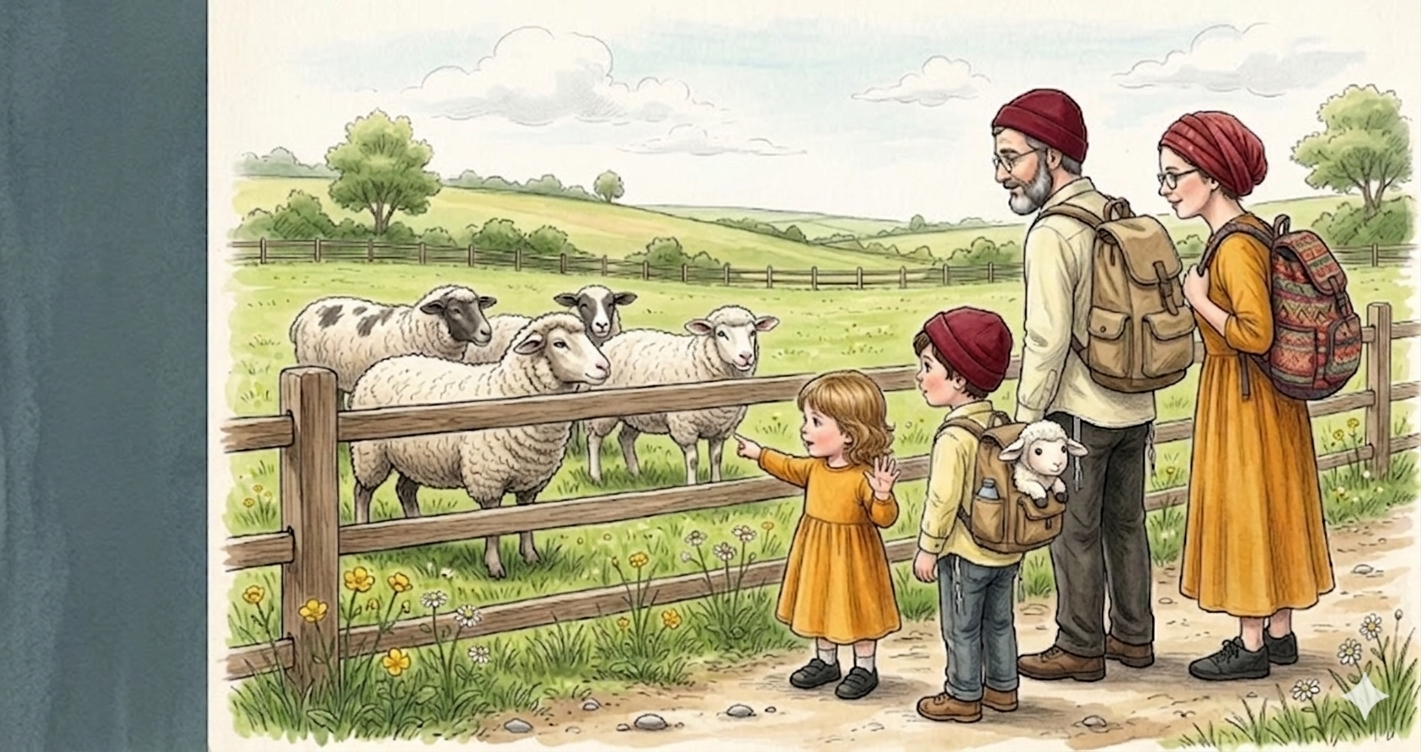
- When on a walk, include numbers in your talk (e.g., “Oh look, there are four sheep in the pasture.”).
- When coming back from shopping, include numbers in your talk (e.g., “Let’s put all three yogurts that we bought into the fridge.”)
- When helping your toddler get dressed, include numbers in your talk (e.g., “Let’s close the snaps on your shirt. It has one, two, three, four snaps.”)
- When celebrating a holiday, include numbers (e.g., count candles during Chanukah)
- When playing, include numbers in your talk (e.g., “Let’s play two rounds.”)
- Sometimes engage in math talk during your daily reading aloud to your child time (e.g., “Wow, there are seven chickens on this page. So many!”)
You get the idea.
Activities to help your child learn to recognize written numbers
Just like with counting, you can simply include written numbers in daily life. For instance,
- Point out your apartment number or house number as you walk by.
- If you’re in an elevator, point out the number of the floor you’re going to.
- If you’re parking in a parking garage, point out the number of the level you’ve parked in.
- During the ‘Counting the Omer’ period, display the current number somewhere where the child can see it.
Moreover, let your child sometimes play with a numbers puzzle as part of his or her toy rotation. That way, your child gets to feel the outline of a number when putting it in the correct spot on the board.
Activities to help your child learn to label simple shapes
Just like with the other two areas, talk about shapes in everyday life.
Additionally, get your child some wood blocks and other building toys like Picasso (or Magna) Tiles. In the 2023 U.S. study, the more frequently the child did “building activities”, the better his or her spatial skills3. Playing with blocks isn’t just good for a child’s math skills. A different study found that toddlers who played with blocks for 6 months scored “significantly higher on language tests than” toddlers who didn’t play with blocks4.
There are also shape puzzles.
Activities to help your child learn to understand the meaning of ‘next to’ and similar words
The 2023 U.S. study5 also found that
- The more the parents’ words during an activity included “locations, directions, orientations”, the better the toddler’s spatial skills.
- But, the more the parents simply used words such as “here” and “there” or “where”, the worse the toddler’s spatial skills.
So instead of just saying “Can you put your toy there, please?”, be specific. “Let’s put away your toys for the night now. Let’s put your doll next to the wood blocks on the shelf.”
Activities to help your child learn to compare two things or sets and to understand simple addition and subtraction
The 2023 U.S. study mentioned above didn’t specifically look at these skills. But including talk about it in everyday life is a good starting point. For instance,
- Eating (e.g., “You can have three cookies. You’ve already eaten two, so you have one left.”)
- Playing with or putting toys away (e.g., “A cube would work well for this part of the building. We already have four square tiles, but we need six to build a cube. So let’s grab two more.“ or “So how many more do we need?“)
- Shopping (e.g., “This jar of apple sauce is bigger than the other one.“)
You get the idea.
Some toys can also encourage practicing comparisons, for instance,
- a puzzle that has circles in different sizes,
- animal figures in different sizes, such as a big and a little sheep figure.
Conclusion
The cool thing about the results of the 2023 U.S. study6 is that the strategies work without taking time away from play. You can develop your toddler’s math skills by doing what you’re doing anyway and just including talking about math concepts, such as numbers and shapes. Moreover, let your child play with building blocks.
The 2023 U.S. study also found that the more diverse the “number activities”, the better the toddler’s spatial reasoning skills7. Practice numbers in different contexts.
References
- e.g.,
CDC (n.d.). Milestone checklists. https://www.cdc.gov/ncbddd/actearly/pdf/LTSAE-Checklist_COMPLIANT_30MCorrection_508.pdf (last checked Aug 20, 2023)
Children first (2015). RESOURCE: Assessing Kindergarten Readiness in Pennsylvania – Jan 2015 https://www.childrenfirstpa.org/report/pennsylvanias-kindergarten-readiness-assessment/ (last checked Aug 20, 2023)
Pennsylvania Learning Standards for Early Childhood. Infants – Toddlers https://s35729.pcdn.co/wp-content/uploads/2017/11/2014-Pennsylvania-Learning-Standards-for-Early-Childhood-Infants-Toddlers.pdf (last checked Aug 20, 2023) ↩︎ - Miller, P.; Elliot, L.E., Podvysotska, T.; Ptak, C.; Duong, S.; Fox, D.; Coulanges, L.; Libertus, M; Bachman, H.J.; & Votruba-Drzal, E. (2023). Toddler home math environment: Triangulating multi-method assessments in a U.S. Sample https://www.frontiersin.org/articles/10.3389/fpsyg.2023.1105569/full (last checked Aug 20, 2023) ↩︎
- Miller,P.; Elliot, L.E., Podvysotska, T.; Ptak, C.; Duong, S.; Fox, D.; Coulanges, L.; Libertus, M; Bachman, H.J.; & Votruba-Drzal, E. (2023). Toddler home math environment: Triangulating multi-method assessments in a U.S. Sample https://www.frontiersin.org/articles/10.3389/fpsyg.2023.1105569/full (last checked Aug 20, 2023) ↩︎
- see Wenner Moyer, M. (2016). Unstructured Play Is Critical to Child Development. https://www.scientificamerican.com/article/unstructured-play-is-critical-to-child-development/ (last checked Aug 20, 2023) ↩︎
- Miller, P.; Elliot, L.E., Podvysotska, T.; Ptak, C.; Duong, S.; Fox, D.; Coulanges, L.; Libertus, M; Bachman, H.J.; & Votruba-Drzal, E. (2023). Toddler home math environment: Triangulating multi-method assessments in a U.S. Sample https://www.frontiersin.org/articles/10.3389/fpsyg.2023.1105569/full (last checked Aug 20, 2023) ↩︎
- Miller, P.; Elliot, L.E., Podvysotska, T.; Ptak, C.; Duong, S.; Fox, D.; Coulanges, L.; Libertus, M; Bachman, H.J.; & Votruba-Drzal, E. (2023). Toddler home math environment: Triangulating multi-method assessments in a U.S. Sample https://www.frontiersin.org/articles/10.3389/fpsyg.2023.1105569/full (last checked Aug 20, 2023) ↩︎
- Miller, P.; Elliot, L.E., Podvysotska, T.; Ptak, C.; Duong, S.; Fox, D.; Coulanges, L.; Libertus, M; Bachman, H.J.; & Votruba-Drzal, E. (2023). Toddler home math environment: Triangulating multi-method assessments in a U.S. Sample https://www.frontiersin.org/articles/10.3389/fpsyg.2023.1105569/full (last checked Aug 20, 2023) ↩︎