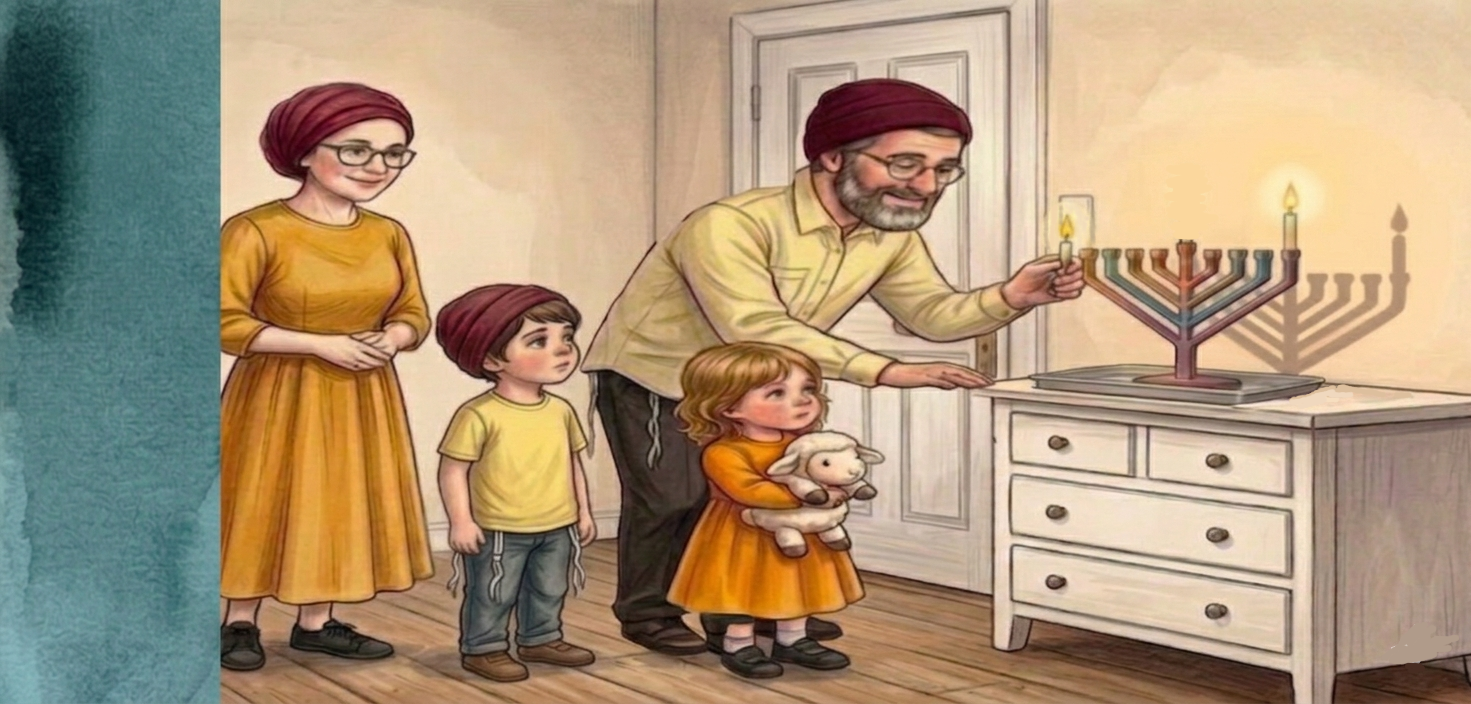

Chanukah is an 8-day holiday. Every night, one more candle is lit, using a helper candle (shamash). So, by observing it, children can practice counting to 9. But that’s not the only way one can practice math skills. Here are some ideas for fun Hanukah activities.
Some research shows that early number activities at home predict math ability.1 Better supporting children’s learning in everyday activities at home can have a positive impact.2
Menorah building
A Chanukah Menorah consists of 8 candles that are in one line, as well as a 9th candle (the Shamash, a helper candle), which is higher or lower than the rest. Thus, building a menorah naturally includes counting 🙂
Working Menorah
Some Chabad houses offer free workshops to build a working menorah (i.e., one that can be used to light with real candles or oil lamps).
If you want to do one at home, here are DIY instructions using tiles and hex nuts. The pictures show some menorahs that aren’t actually kosher because the candles are not in a line. To avoid that, mark two parallel lines on the base tile beforehand to indicate where the candles should go.
For another option, here are DIY instructions using clay.
Play Menorah
One can build play menorahs (i.e., those not to be used with real flames) from many different materials. For example:
Magnetic Tiles
Magnetic tiles such as Picasso tiles or Magna-Tiles can be used to make a menorah. Grab your free menorah tile toppers here.
Lego
BiblebeltBalabusta shows examples of making Lego and Duplo menorahs (Note: Duplo is not fire-safe, so these are NOT for lighting).
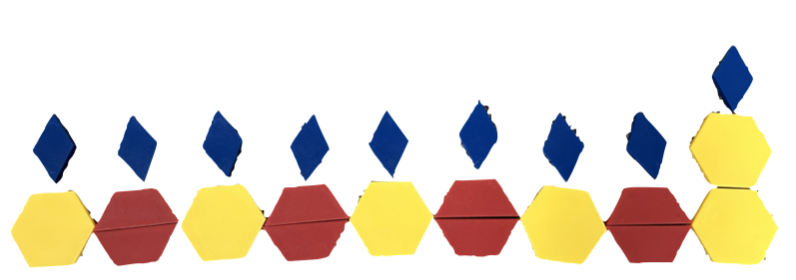
Pattern blocks
Pattern blocks can be used to make a menorah. One example:
Felt
It’s easy to make a feltboard menorah. Cut out the base, 9 candles, and 9 flames separately.
Clothespins
Put a picture of a menorah on cardboard or use folded craft paper to create a base. Attach paper “flames” to clothespins to make candles. KiwiCo has an example, as does WithLoveIma.
Toilet paper rolls and cardboard
WithLoveIma suggests making a menorah out of toilet paper rolls with craft stick “candles”.
Commercial toys
Of course, there are also a variety of commercial toy menorahs available, for instance, made out of wood.
Dreidel/ Sevivon
Playing Dreidel involves division by 2 whenever it lands on the letter hey. Read the rules of how to play Dreidel here.
Dreidels can also be used for graphing. This one from WithLoveIma has the colors written in (blue, white, red, green, yellow). This makes it hard to do if your dreidels are purple, orange, and brown, for instance. Therefore, I created one where the child completes the colors in the legend. Grab the free worksheet here.
Instead of using different dreidels, one can also spin a dreidel and graph the results. WithLoveIma has a free printable for that.
Holiday symbols
WithLoveIma has many ideas for activities that use holiday symbols for counting practice. For instance, one can
- put dreidels into 10-frames or 20-frames (or if you have a lot, a 100-chart), the same works for gelt
- count Chanukah candles (instead of 0-9, you can do 2-9 to prepare the candles to be used for each night)
- count latkes
One could also make up multiplication and addition problems (for instance, about eating a certain number of sufganiot per person and/or per day).
Rachel Retter suggests discussing Gauss’s formula to find out the number of candles needed for the whole holiday.
Holiday Story
In Tilda Balsley’s picture book “Maccabee! The Story of Hanukkah” a recurring phrase is
“Sometimes it only takes a few, who know what’s right and do it, too.”
Beyond counting opportunities (5 brothers, Menorah burning for 8 nights, …) that are associated with the Chanukah story, Balsley’s sentence also invites the discussion of “few” as a “small number” and how that depends on the context and what one is comparing it to (for instance, cookies eaten in a day vs. people that live in a place).
The Greek army had around 40,000 men. How big was the Maccabee army? In the book 1 Maccabee (Chapter 9), it talks about how at one point, many of the 3000 men deserted, leaving Yehudah with only 800, while at another point (Chapter 4) Yehudah had 10,000 men. At most, there might have been a total of 12,000 men. Other sources talk about how the Maccabees were frequently “outnumbered 10 to one“.
WithLoveIma suggests using peg dolls to let kids retell the Chanukah story. One could also use felt board pieces.
To illustrate the difference between few and many, one could focus on the ratios (1:4 to 1:10).
Holiday countdown
WithLoveIma suggests displaying a holiday countdown.
References
- e.g.,
Blevins-Knabe, B. and Musun-Miller, L. (1996). Number Use at Home by Children and Their Parents and Its Relationship to Early Mathematical Performance. Abstract. https://onlinelibrary.wiley.com/doi/abs/10.1002/(SICI)1099-0917(199603)5:1%3C35::AID-EDP113%3E3.0.CO;2-0
Susperreguy, M.I., Di Lonardo Burr, S., Xu, C., Douglas, H. and LeFevre, J.-A (2020) Children’s home numeracy environment predicts growth of their early mathematical skills in kindergarten. Abstract. https://eprints.whiterose.ac.uk/id/eprint/206223/1/Susperreguy%20et%20al.%202020%20Child%20Dev.pdf
Pan, Y., Hu, B. Y., Hunt, J., Wu, Z., Chen, Y., and He, M. (2022). Chinese Preschool Children’s Home Numeracy Experiences and their Mathematical Abilities. Abstract. https://journals.sagepub.com/doi/abs/10.1177/1476718X221125583 ↩︎ - Niklas, F., Cohrsse, C, and Tayler, C (2015). Home Learning Environment and Concept Formation: A Family Intervention Study with Kindergarten Children. Abstract. https://www.hogent.be/sites/hogent/assets/File/Pdf_8-Niklas_et_al_2015_improving_preschool_home_numeracy_environment.pdf ↩︎