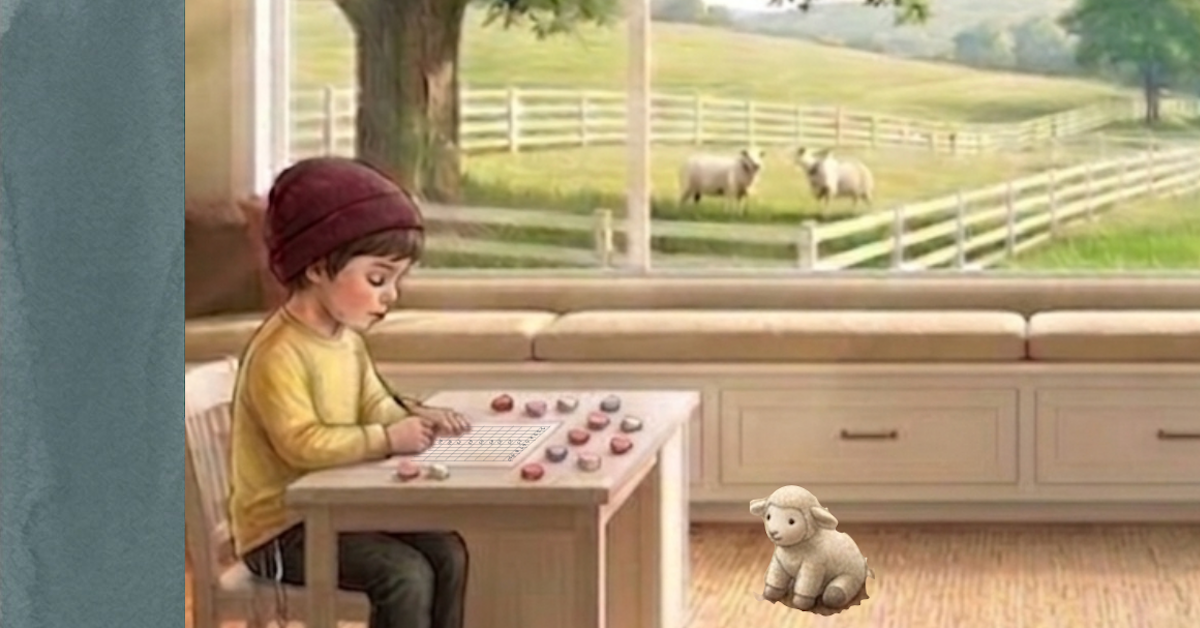

A 0-100 chart (or 1-100 chart) isn’t just for counting. It can be used for a surprising range of math. There are lots of activities you can do with a 100 chart – and many people offering 100-chart printables. If you’re looking for a free 0-100 chart, make sure that you use one where the numbers are right-aligned, so that the ‘ones’ are aligned between 8 and 18, for instance. Also, make sure to use a top-down chart (smallest number on top), not a bottom-up chart (smallest number on the bottom). One small study with kindergarten and first-grade students found that the top-down chart was more effective for children learning place value and finding the solution for subtraction problems than the bottom-up chart1.
You can download a free chart here: 0-100 Chart
Once you have your chart, here are several activities to try.
Recognizing written numbers
For early learning, the 100 chart can be a reference in practicing counting and recognizing the way numbers are written. Talk with your child about the numbers. Answer their questions (This is…?) – and ask some of your own.
You don’t need to start looking at all the numbers. For instance, after using puzzles and other more hands-on ways, you can start with just 0 to 9 or 10.
Later, you can look at more numbers when the learner learns about higher numbers. You can combine that with, e.g., talking about 10-rods and single pieces to help explain why numbers are written that way.
Counting
You can use 0-100 charts to practice counting and ‘counting on’ from numbers other than 1.
You can also practice counting by twos, fives, tens, etc. (skip-counting)2.
Specific numbers
You can have your child point to a specific number, such as “point to 9”. Or they can put a counter (such as a small eraser) or piece of tape on that number. If your learner already knows how to color inside the lines (or how to use dot markers only on a specific spot), they could also color the number.
You can also put counters or tape on specific numbers and ask your learner which number hides underneath. The learner can say the number and then check by him- or herself whether the answer is correct.3
Jill Staake also describes a scavenger hunt. Numbers are written on sticky notes in a size that matches the chart used and then hidden around the room. The learner finds the pieces and then puts them in the correct spots on the chart.4
For those children who can already write (or can use number stamps with sufficient precision), you can also have them write or stamp in missing numbers. 5 You can also tape little pieces of paper onto a laminated 100-chart for the students to write on, then have them check underneath.
For children who can already color within the lines or use dot markers with sufficient precision, there are also printables where they are asked to color specific numbers so that a picture or letter is revealed.6
Addition and subtraction
A 100 chart can also be used to practice adding and subtracting after having introduced the concept in more hands-on ways.
Learners can be asked to find “one more”, “one less”, or “10 more”, etc., than a given number. Later, other addition or subtraction problems can be used (such as +2). The learners can use the 100-chart to count from the starting number or for problems such as +12, move one line down (+10), and then count +2.7
Jill Staake8 encourages educators to have an anchor chart with the following information: “
- moving ↑ a row is subtracting 10
- moving ↓ a row is adding 10
- moving ← is subtracting 1
- moving → is adding 1″
She also describes making a little cardboard overlay with flaps and those descriptions. While the one featured in her article has the descriptions “10 more” etc., you can also use the mathematical notation (+10).
One can use the 100-chart for a simple game. Two players start at 1. They take turns rolling a die and moving a counter ahead until 100 is reached. One can also start at 100 and move backward.9
Chart puzzles
There are two ways a 100 chart can be made into a puzzle:10
- Cut a chart into pieces to make a puzzle
- Buy a cheap 100-piece jigsaw puzzle (10 rows x 10 columns) and label the puzzle pieces on the back with the numbers 1-100
Number bonds
A number bond is two numbers that add up to a specific number. For instance, the number 4 can be split into 0+4, 1+3, 3+1, or 2+2. Learners can use counters on the 100-chart to find number bonds for a specific number.11
Patterns
Learners can look for patterns in times tables, such as coloring in (or placing markers on) multiples of 2 (or 5, or 10, etc.).12
Fractions and percentages
Because of the way a 100-chart is organized, it can be used to illustrate fractions (tenths and hundredths) and percentages. For this, one could also use a blank chart, without the numbers written in.13
References
- Wagner, Vera (2022). The Impact of Different Types of Hundreds Charts on Place Value and Number Sense in Kindergarten and First-Grade (Abstract). Thesis, Concordia University. https://spectrum.library.concordia.ca/id/eprint/990365/ ↩︎
- Staake, Jill (2020) 20 Hundreds Chart Activities to Teach Counting, Number Sense, and More https://www.weareteachers.com/hundreds-chart/ ↩︎
- see also e.g., Marlow, Lauren (2024) 10 of the best 100 Chart activities for elementary school https://thirdspacelearning.com/us/blog/100-chart/ ↩︎
- Staake, Jill (2020) 20 Hundreds Chart Activities to Teach Counting, Number Sense, and More https://www.weareteachers.com/hundreds-chart/ ↩︎
- Staake, Jill(2020) 20 Hundreds Chart Activities to Teach Counting, Number Sense, and More https://www.weareteachers.com/hundreds-chart/
Marlow, Lauren (2024) 10 of the best 100 Chart activities for elementary school https://thirdspacelearning.com/us/blog/100-chart/
↩︎ - Staake, Jill (2020) 20 Hundreds Chart Activities to Teach Counting, Number Sense, and More https://www.weareteachers.com/hundreds-chart/ ↩︎
- Marlow, Lauren (2024) 10 of the best 100 Chart activities for elementary school https://thirdspacelearning.com/us/blog/100-chart/
Heirdsfield, Ann (2011). Teaching mental computation strategies in early mathematics. YC Young Children, 66(2), pp. 96-102. https://eprints.qut.edu.au/42451/1/42451.pdf ↩︎ - Staake, Jill (2020) 20 Hundreds Chart Activities to Teach Counting, Number Sense, and More https://www.weareteachers.com/hundreds-chart/ ↩︎
- Staake, Jill (2020) 20 Hundreds Chart Activities to Teach Counting, Number Sense, and More https://www.weareteachers.com/hundreds-chart/
Marlow, Lauren (2024) 10 of the best 100 Chart activities for elementary school https://thirdspacelearning.com/us/blog/100-chart/ ↩︎ - Staake, Jill (2020) 20 Hundreds Chart Activities to Teach Counting, Number Sense, and More https://www.weareteachers.com/hundreds-chart/
Marlow, Lauren (2024) 10 of the best 100 Chart activities for elementary school https://thirdspacelearning.com/us/blog/100-chart/ ↩︎ - Marlow, Lauren (2024) 10 of the best 100 Chart activities for elementary school https://thirdspacelearning.com/us/blog/100-chart/ ↩︎
- Marlow, Lauren (2024) 10 of the best 100 Chart activities for elementary school https://thirdspacelearning.com/us/blog/100-chart/ ↩︎
- Marlow, Lauren (2024) 10 of the best 100 Chart activities for elementary school https://thirdspacelearning.com/us/blog/100-chart/ ↩︎